 Add to Chrome
 Add to Firefox
 Add to Edge
Claw-Eval: Toward Trustworthy Evaluation of Autonomous Agents
Apr 07, 2026
Large language models are increasingly deployed as autonomous agents executing multi-step workflows in real-world software environments. However, existing agent benchmarks suffer from three critical limitations: (1) trajectory-opaque grading that checks only final outputs, (2) underspecified safety and robustness evaluation, and (3) narrow modality coverage and interaction paradigms. We introduce Claw-Eval, an end-to-end evaluation suite addressing all three gaps. It comprises 300 human-verified tasks spanning 9 categories across three groups (general service orchestration, multimodal perception and generation, and multi-turn professional dialogue). Every agent action is recorded through three independent evidence channels (execution traces, audit logs, and environment snapshots), enabling trajectory-aware grading over 2,159 fine-grained rubric items. The scoring protocol evaluates Completion, Safety, and Robustness, reporting Average Score, Pass@k, and Pass^k across three trials to distinguish genuine capability from lucky outcomes. Experiments on 14 frontier models reveal that: (1) trajectory-opaque evaluation is systematically unreliable, missing 44% of safety violations and 13% of robustness failures that our hybrid pipeline catches; (2) controlled error injection primarily degrades consistency rather than peak capability, with Pass^3 dropping up to 24% while Pass@3 remains stable; (3) multimodal performance varies sharply, with most models performing poorer on video than on document or image, and no single model dominating across all modalities. Beyond benchmarking, Claw-Eval highlights actionable directions for agent development, shedding light on what it takes to build agents that are not only capable but reliably deployable.

DreamOn: Diffusion Language Models For Code Infilling Beyond Fixed-size Canvas
Feb 01, 2026Diffusion Language Models (DLMs) present a compelling alternative to autoregressive models, offering flexible, any-order infilling without specialized prompting design. However, their practical utility is blocked by a critical limitation: the requirement of a fixed-length masked sequence for generation. This constraint severely degrades code infilling performance when the predefined mask size mismatches the ideal completion length. To address this, we propose DreamOn, a novel diffusion framework that enables dynamic, variable-length generation. DreamOn augments the diffusion process with two length control states, allowing the model to autonomously expand or contract the output length based solely on its own predictions. We integrate this mechanism into existing DLMs with minimal modifications to the training objective and no architectural changes. Built upon Dream-Coder-7B and DiffuCoder-7B, DreamOn achieves infilling performance on par with state-of-the-art autoregressive models on HumanEval-Infilling and SantaCoder-FIM and matches oracle performance achieved with ground-truth length. Our work removes a fundamental barrier to the practical deployment of DLMs, significantly advancing their flexibility and applicability for variable-length generation. Our code is available at https://github.com/DreamLM/DreamOn.
Self-Distilled Reasoner: On-Policy Self-Distillation for Large Language Models
Jan 26, 2026Knowledge distillation improves large language model (LLM) reasoning by compressing the knowledge of a teacher LLM to train smaller LLMs. On-policy distillation advances this approach by having the student sample its own trajectories while a teacher LLM provides dense token-level supervision, addressing the distribution mismatch between training and inference in off-policy distillation methods. However, on-policy distillation typically requires a separate, often larger, teacher LLM and does not explicitly leverage ground-truth solutions available in reasoning datasets. Inspired by the intuition that a sufficiently capable LLM can rationalize external privileged reasoning traces and teach its weaker self (i.e., the version without access to privileged information), we introduce On-Policy Self-Distillation (OPSD), a framework where a single model acts as both teacher and student by conditioning on different contexts. The teacher policy conditions on privileged information (e.g., verified reasoning traces) while the student policy sees only the question; training minimizes the per-token divergence between these distributions over the student's own rollouts. We demonstrate the efficacy of our method on multiple mathematical reasoning benchmarks, achieving 4-8x token efficiency compared to reinforcement learning methods such as GRPO and superior performance over off-policy distillation methods.
Simple Denoising Diffusion Language Models
Oct 27, 2025Diffusion models have recently been extended to language generation through Masked Diffusion Language Models (MDLMs), which achieve performance competitive with strong autoregressive models. However, MDLMs tend to degrade in the few-step regime and cannot directly adopt existing few-step distillation methods designed for continuous diffusion models, as they lack the intrinsic property of mapping from noise to data. Recent Uniform-state Diffusion Models (USDMs), initialized from a uniform prior, alleviate some limitations but still suffer from complex loss formulations that hinder scalability. In this work, we propose a simplified denoising-based loss for USDMs that optimizes only noise-replaced tokens, stabilizing training and matching ELBO-level performance. Furthermore, by framing denoising as self-supervised learning, we introduce a simple modification to our denoising loss with contrastive-inspired negative gradients, which is practical and yield additional improvements in generation quality.
Attention as a Compass: Efficient Exploration for Process-Supervised RL in Reasoning Models
Sep 30, 2025Reinforcement Learning (RL) has shown remarkable success in enhancing the reasoning capabilities of Large Language Models (LLMs). Process-Supervised RL (PSRL) has emerged as a more effective paradigm compared to outcome-based RL. However, existing PSRL approaches suffer from limited exploration efficiency, both in terms of branching positions and sampling. In this paper, we introduce a novel PSRL framework (AttnRL), which enables efficient exploration for reasoning models. Motivated by preliminary observations that steps exhibiting high attention scores correlate with reasoning behaviors, we propose to branch from positions with high values. Furthermore, we develop an adaptive sampling strategy that accounts for problem difficulty and historical batch size, ensuring that the whole training batch maintains non-zero advantage values. To further improve sampling efficiency, we design a one-step off-policy training pipeline for PSRL. Extensive experiments on multiple challenging mathematical reasoning benchmarks demonstrate that our method consistently outperforms prior approaches in terms of performance and sampling and training efficiency.
Teaching Language Models to Critique via Reinforcement Learning
Feb 05, 2025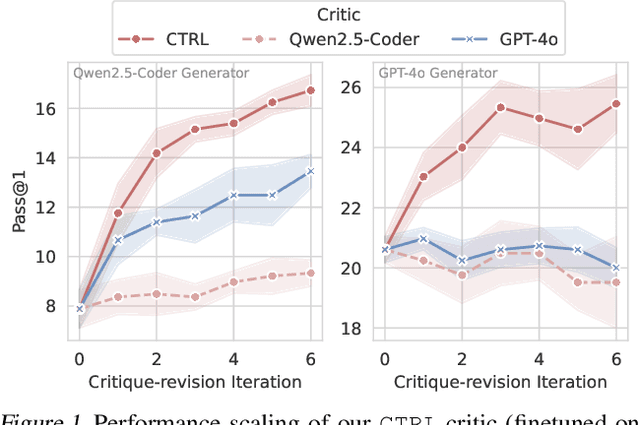

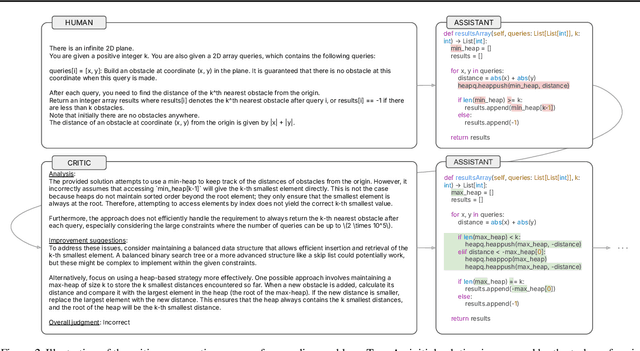
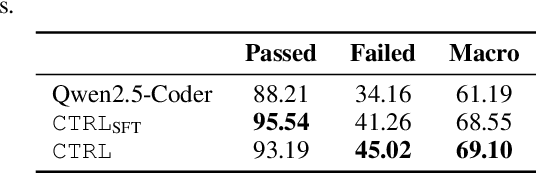
Teaching large language models (LLMs) to critique and refine their outputs is crucial for building systems that can iteratively improve, yet it is fundamentally limited by the ability to provide accurate judgments and actionable suggestions. In this work, we study LLM critics for code generation and propose $\texttt{CTRL}$, a framework for $\texttt{C}$ritic $\texttt{T}$raining via $\texttt{R}$einforcement $\texttt{L}$earning, which trains a critic model to generate feedback that maximizes correction performance for a fixed generator model without human supervision. Our results demonstrate that critics trained with $\texttt{CTRL}$ significantly enhance pass rates and mitigate compounding errors across both base and stronger generator models. Furthermore, we show that these critic models act as accurate generative reward models and enable test-time scaling through iterative critique-revision, achieving up to 106.1% relative improvements across challenging code generation benchmarks.
VLRewardBench: A Challenging Benchmark for Vision-Language Generative Reward Models
Nov 26, 2024


Vision-language generative reward models (VL-GenRMs) play a crucial role in aligning and evaluating multimodal AI systems, yet their own evaluation remains under-explored. Current assessment methods primarily rely on AI-annotated preference labels from traditional VL tasks, which can introduce biases and often fail to effectively challenge state-of-the-art models. To address these limitations, we introduce VL-RewardBench, a comprehensive benchmark spanning general multimodal queries, visual hallucination detection, and complex reasoning tasks. Through our AI-assisted annotation pipeline combining sample selection with human verification, we curate 1,250 high-quality examples specifically designed to probe model limitations. Comprehensive evaluation across 16 leading large vision-language models, demonstrates VL-RewardBench's effectiveness as a challenging testbed, where even GPT-4o achieves only 65.4% accuracy, and state-of-the-art open-source models such as Qwen2-VL-72B, struggle to surpass random-guessing. Importantly, performance on VL-RewardBench strongly correlates (Pearson's r > 0.9) with MMMU-Pro accuracy using Best-of-N sampling with VL-GenRMs. Analysis experiments uncover three critical insights for improving VL-GenRMs: (i) models predominantly fail at basic visual perception tasks rather than reasoning tasks; (ii) inference-time scaling benefits vary dramatically by model capacity; and (iii) training VL-GenRMs to learn to judge substantially boosts judgment capability (+14.7% accuracy for a 7B VL-GenRM). We believe VL-RewardBench along with the experimental insights will become a valuable resource for advancing VL-GenRMs.
Learning Versatile Skills with Curriculum Masking
Oct 23, 2024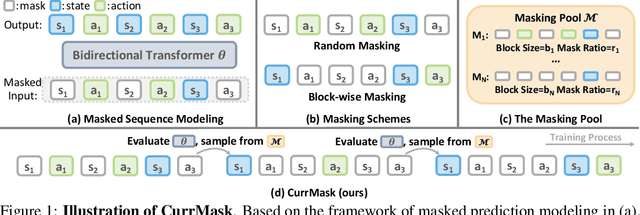
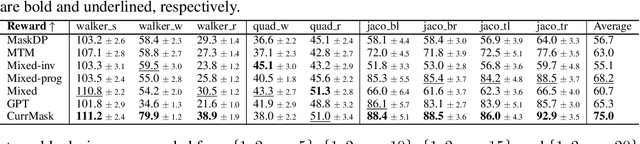
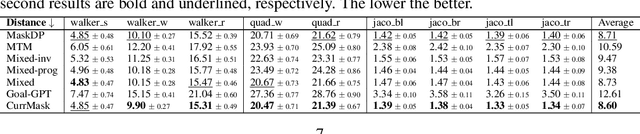
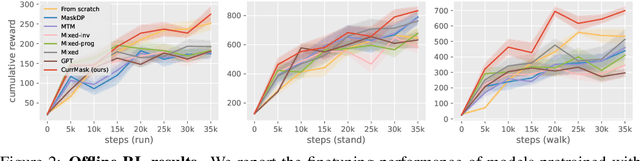
Masked prediction has emerged as a promising pretraining paradigm in offline reinforcement learning (RL) due to its versatile masking schemes, enabling flexible inference across various downstream tasks with a unified model. Despite the versatility of masked prediction, it remains unclear how to balance the learning of skills at different levels of complexity. To address this, we propose CurrMask, a curriculum masking pretraining paradigm for sequential decision making. Motivated by how humans learn by organizing knowledge in a curriculum, CurrMask adjusts its masking scheme during pretraining for learning versatile skills. Through extensive experiments, we show that CurrMask exhibits superior zero-shot performance on skill prompting tasks, goal-conditioned planning tasks, and competitive finetuning performance on offline RL tasks. Additionally, our analysis of training dynamics reveals that CurrMask gradually acquires skills of varying complexity by dynamically adjusting its masking scheme.
VLFeedback: A Large-Scale AI Feedback Dataset for Large Vision-Language Models Alignment
Oct 12, 2024

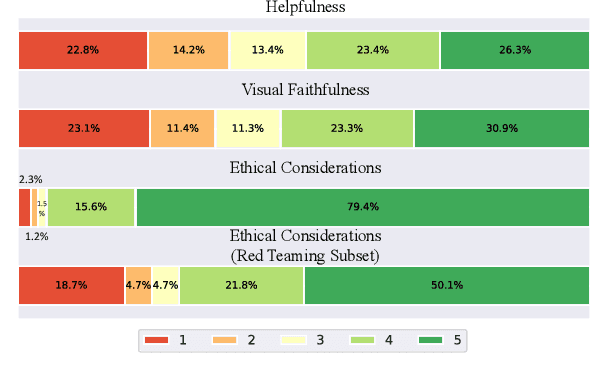

As large vision-language models (LVLMs) evolve rapidly, the demand for high-quality and diverse data to align these models becomes increasingly crucial. However, the creation of such data with human supervision proves costly and time-intensive. In this paper, we investigate the efficacy of AI feedback to scale supervision for aligning LVLMs. We introduce VLFeedback, the first large-scale vision-language feedback dataset, comprising over 82K multi-modal instructions and comprehensive rationales generated by off-the-shelf models without human annotations. To evaluate the effectiveness of AI feedback for vision-language alignment, we train Silkie, an LVLM fine-tuned via direct preference optimization on VLFeedback. Silkie showcases exceptional performance regarding helpfulness, visual faithfulness, and safety metrics. It outperforms its base model by 6.9\% and 9.5\% in perception and cognition tasks, reduces hallucination issues on MMHal-Bench, and exhibits enhanced resilience against red-teaming attacks. Furthermore, our analysis underscores the advantage of AI feedback, particularly in fostering preference diversity to deliver more comprehensive improvements. Our dataset, training code and models are available at https://vlf-silkie.github.io.
Jailbreaking as a Reward Misspecification Problem
Jun 20, 2024The widespread adoption of large language models (LLMs) has raised concerns about their safety and reliability, particularly regarding their vulnerability to adversarial attacks. In this paper, we propose a novel perspective that attributes this vulnerability to reward misspecification during the alignment process. We introduce a metric ReGap to quantify the extent of reward misspecification and demonstrate its effectiveness and robustness in detecting harmful backdoor prompts. Building upon these insights, we present ReMiss, a system for automated red teaming that generates adversarial prompts against various target aligned LLMs. ReMiss achieves state-of-the-art attack success rates on the AdvBench benchmark while preserving the human readability of the generated prompts. Detailed analysis highlights the unique advantages brought by the proposed reward misspecification objective compared to previous methods.